
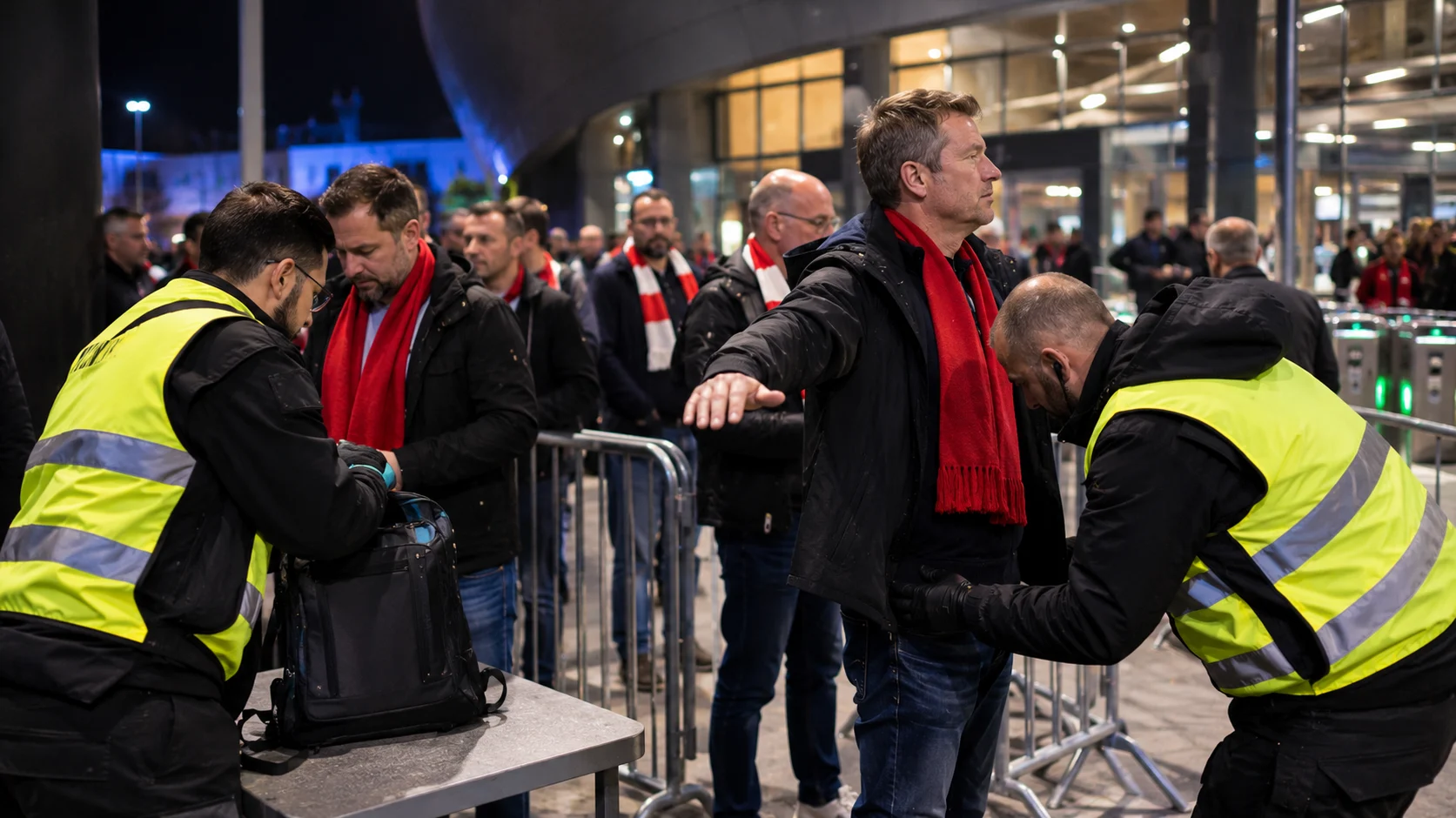
Many supporters assume Spain’s strict stadium rules are a football thing. They are not. If you are following your team to a EuroLeague game in Madrid, Barcelona, Vitoria-Gasteiz or Valencia, the same Spanish sports violence law that governs football grounds also shapes what happens at the arena door. This guide explains how basketball fans and Spain law meet in practice: access conditions, alcohol, pyrotechnics, banners, high-risk declarations, fines, the risk of a banning order in Spain, and what to do if something goes wrong.
Need legal help in Spain now? Our lawyers support European football and EuroLeague basketball fans before, during and after the game. Contact us or message us on WhatsApp. We reply quickly, in English, Spanish, French, German, Italian or Portuguese.
Basketball fans, Spain law and the EuroLeague
Two texts matter most. The first is Ley 19/2007, Spain’s law against violence, racism, xenophobia and intolerance in sport. The second is Real Decreto 203/2010, the regulation that develops it. Neither is limited to football. They are written for sport in general, and Spanish basketball venues apply them every week.
Formally, the law’s scope is built around official competitions of state level under Spanish sports legislation and competitions organised or authorised by Spanish sports federations. EuroLeague is a private international competition, but in practice Spanish authorities treat its games in Spain as covered:
- The venue regulations of FC Barcelona’s Palau Blaugrana and Valencia Basket’s Roig Arena expressly cite Ley 19/2007.
- Spain’s State Commission against Violence in Sport has declared EuroLeague basketball games high risk, including games involving Israeli clubs.
- In May 2026, local press reported that the Commission proposed fines totalling 20,000 euros against Baskonia over two EuroLeague home games, including a failure to tell the police security coordinator how many tickets had been sold to Crvena Zvezda fans and where they were seated.
For a visiting fan, the safe working assumption is simple: behave as if the full Spanish regime applies. Whether a particular proceeding is legally well founded is a question for a lawyer afterwards, not an argument to have with a steward.
Access conditions: what the law expects at the door
Ley 19/2007 sets conditions to enter and to stay in a sports venue. Among other things, you must not:
- bring in weapons or objects that could be used as such, or flares, fireworks, firecrackers and similar items;
- enter under the influence of alcohol or drugs, or drink alcohol inside;
- display banners, symbols or chants that incite violence, or that are racist, xenophobic or otherwise discriminatory;
- throw objects or enter the playing area;
- refuse CCTV recording or a personal search at the entrance;
- enter without a valid ticket, or sit somewhere other than the seat your ticket gives you.
Breaking the conditions of entry means you can be refused access. Breaking them once inside means the police can remove you immediately, and a sanction file can follow later.
Alcohol
RD 203/2010 prohibits introducing and selling alcoholic drinks (defined as above 1% alcohol) in venues hosting competitions within its scope, and people showing signs of intoxication can be refused entry. Real Madrid’s published access rules for the Movistar Arena ban alcohol and entering under its influence. Valencia Basket allows only water, in a clear container of 50 cl or less with the cap removed. Drinking in the street before the game is a separate matter governed by local by-laws, which vary by city.
Flares and pyrotechnics
Pyrotechnics are banned for spectators. Under RD 203/2010 they can only be used by authorised professionals designated by the organiser, with the security coordinator’s agreement. Carrying a flare in your bag is enough to be refused entry and reported. Our guide to flares and fines in Spain explains the risks in detail; they are the same indoors, and arguably more dangerous in a closed arena.
Banners, flags and drums
The law bans banners and symbols that incite violence or discrimination, and stewards can remove them. Clubs add their own rules. The Palau Blaugrana requires prior authorisation from the club for flags and banners, with a maximum of 2 x 3 metres and no sticks. Valencia Basket sets the same maximum size, allows megaphones and drums only with authorisation, and can ban flags and team symbols under its reinforced security protocol. If your group plans a display, ask your own club to request permission well in advance.
High-risk declarations for basketball games
The State Commission against Violence in Sport can declare a game high risk, on a proposal from the organisers or on its own initiative. The minimum consequences include controlled ticket sales, separation of rival fans, stricter access control and any additional entry measures judged necessary. Visiting groups may be escorted by police.
For EuroLeague fans this has real effects. Some games have been played behind closed doors on security grounds, such as Valencia Basket against Hapoel Tel Aviv in October 2025. At high-risk games, expect earlier arrival times, fewer open gates, more searches and identity checks. Our page on high-risk matches in Spain explains what to expect. The rules for police escorts are covered in our guide to police escorts and kettling.
Travelling soon? Save +34 600 571 772 in your phone before you leave home. If something happens at the arena, one WhatsApp message puts you in touch with a lawyer who speaks your language.
Fines and banning orders in Spain for basketball fans
Ley 19/2007 classifies infringements as minor (leve), serious (grave) or very serious (muy grave). The fines in the law are:
- Leve: 150 to 3,000 euros.
- Grave: 3,000.01 to 60,000 euros, plus a possible ban from any sports venue of six months to two years.
- Muy grave: 60,000.01 to 650,000 euros, plus a possible ban of two to five years.
A ban covers sports venues across Spain, not just the arena where the incident happened, so it can affect you at football grounds too. Clubs must withdraw season tickets and memberships from banned people. Read more in our guides to fan fines in Spain and stadium bans.
Some conduct goes further. Serious disorder, assaults on stewards or police, or injuries caused by a thrown object can lead to arrest and criminal proceedings under the Criminal Code. If that happens, see our guide on what to do if you are arrested in Spain.
How fines reach foreign fans
Being identified is usually the start. Police may record your passport details at the gate or during an incident, and CCTV is used to identify people afterwards. A sanction file can be opened weeks later, once you are home.
Notices are sent to the address the authorities hold. If they cannot notify you there, Spanish administrative law allows publication in the official State Gazette (BOE) single notice board. Deadlines can then run even if you never saw the notice. The first document normally gives you a short period, counted in Spanish working days, to submit written allegations in Spanish. Missing it can mean losing the best chance to challenge the facts.
What to do if something goes wrong
- Stay calm and follow police and steward instructions, even if you disagree.
- Carry your passport or national ID card; some venues require it.
- Note names, badge numbers, times and witnesses. Keep your ticket.
- Do not sign anything you do not understand. Ask for an interpreter.
- If you receive any notice from a Spanish authority, do not ignore it. Get advice before the deadline.
Frequently asked questions
Does Spain’s sports violence law apply to EuroLeague games?
In practice, yes. Clubs cite Ley 19/2007 in their venue rules, and the State Commission has declared EuroLeague games high risk and opened proceedings over them.
Can I drink beer at a EuroLeague game in Spain?
You cannot bring alcohol in, and you can be refused entry if you appear drunk. Check the host club’s rules before you go.
Can I bring a flag to a basketball arena in Spain?
Often, within size limits and without sticks, but some clubs require prior authorisation and high-risk protocols can ban team symbols. Check with your club.
Will a Spanish fine follow me home?
It can. Notices may be sent abroad or published in the BOE, and deadlines can start running from publication.
How Legal Supporters can help
We are a Madrid-based team of lawyers for European football and EuroLeague basketball fans travelling to Spain, and for clubs and teams. We can help with:
- Preventive advice before your trip on arena rules, banners and high-risk measures.
- On-call support on game day and mediation with police or security staff.
- Assistance at the police station if you are detained.
- Defence against fines and access bans, including allegations and appeals.
- Defence in criminal proceedings.
- Support for supporters’ groups, clubs and teams travelling to Spain.
We work in English, Spanish, French, German, Italian and Portuguese. Contact us or message us on WhatsApp, and see our services for more detail.
Reviewed by Guillermo J. Fernández, football fan lawyer in Madrid and member of the Football Supporters Europe Fan Lawyer Network.