
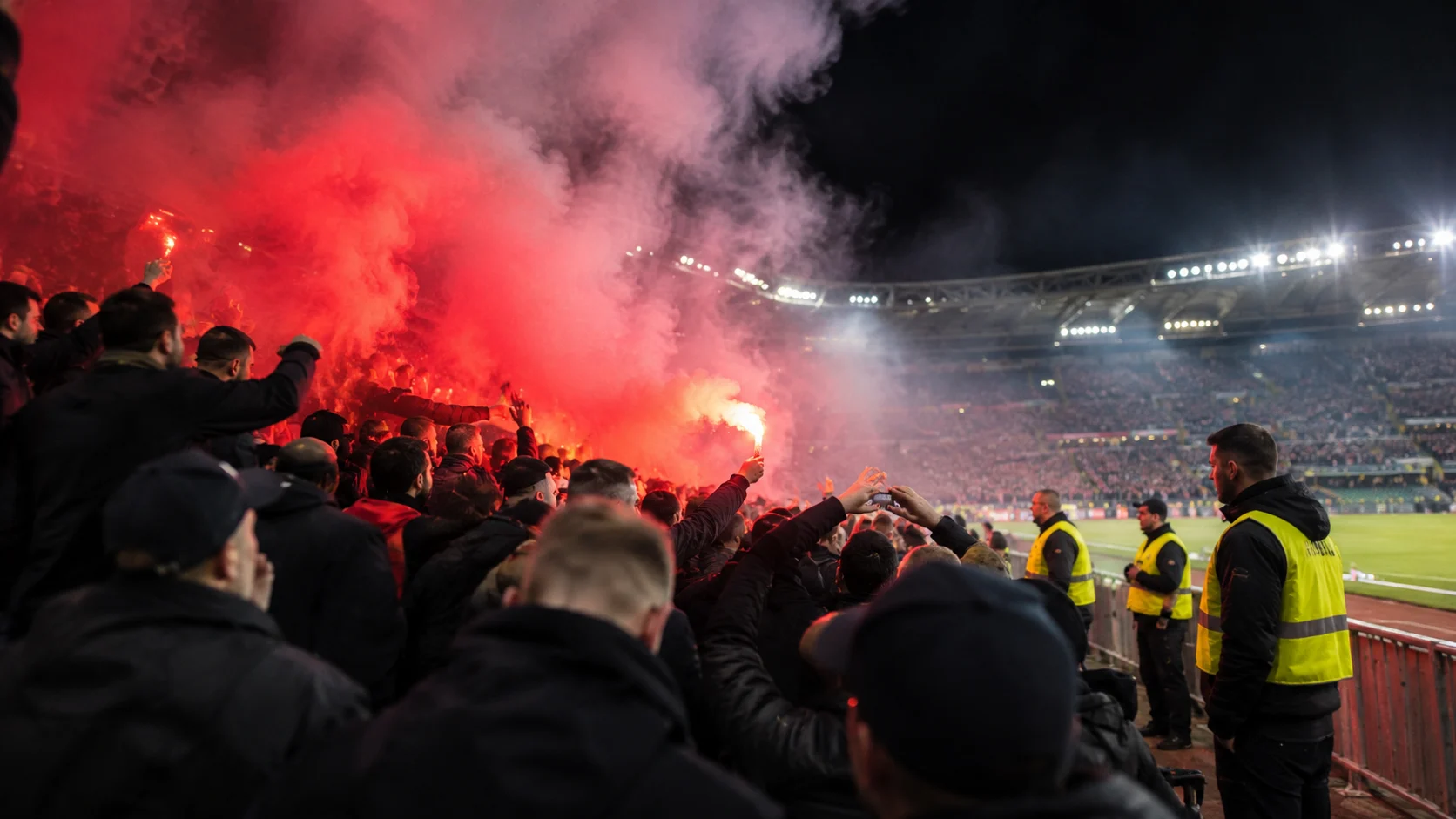
If you are travelling to an away game this season, you need to know how seriously the authorities treat flares at football in Spain. Pyrotechnics that are part of the matchday culture in some countries are banned outright in Spanish stadiums. Lighting one, or simply carrying one through the turnstiles, can lead to a fine starting at several thousand euros, a ban from every sports venue in Spain and, in some cases, a criminal investigation.
Need legal help in Spain now? Our football fan lawyers can advise you before the trip, assist you on matchday and defend you if you receive a fine or stadium ban. Contact us or message us on WhatsApp. We reply quickly, in English.
What Spanish law says about flares at football
The key law is Ley 19/2007, Spain’s law against violence, racism, xenophobia and intolerance in sport. It sets the conditions every spectator must meet to enter and stay in a stadium.
- Entry (article 6.1): it is forbidden to bring in, carry or use weapons or objects that could have similar effects, including flares (bengalas), firecrackers (petardos), explosives and flammable products in general.
- Staying inside (article 7.1): while in the stadium you must not hold, set off or throw those items.
- Tickets (article 11.2): tickets must state the grounds for refusing entry, and carrying flares or similar items is one of them.
Breaking the conditions of permanence means you can be removed from the stadium immediately by the police (article 7.3), and that removal happens regardless of any fine that follows later.
Grave or muy grave: how the offence is classified
Under article 22.2 of Ley 19/2007, breaching the rules in articles 6 and 7 is a serious infringement (grave) for spectators. That is the usual starting point for introducing or using a flare.
It becomes a very serious infringement (muy grave) under article 22.1 when the breach causes damage or a serious risk to people or property, or when other aggravating circumstances described in the law apply. A flare thrown onto the pitch or into a crowd, or one that injures someone, is far more likely to be treated this way.
Fines and stadium bans for flares at football in Spain
Article 24 of Ley 19/2007 sets the penalties. These are the amounts in the published text:
- Leve (minor): fine of 150 to 3,000 euros, and a possible ban from any sports venue of one to six months.
- Grave (serious): fine of 3,000.01 to 60,000 euros, and a possible ban of six months to two years.
- Muy grave (very serious): fine of 60,000.01 to 650,000 euros, and a possible ban of two to five years.
Because flare offences normally fall into the grave category, the minimum fine is just over 3,000 euros. The access ban covers any sports venue in Spain, not just the stadium where it happened. The authorities decide the exact figure according to the circumstances, especially the seriousness and social impact of the conduct. For more on bans, see our guide to stadium bans in Spain.
Fines of up to 60,000 euros are imposed by the Government Delegation (Delegación del Gobierno) in the region concerned, often after a report or proposal from the State Commission against Violence in Sport. Higher amounts go to higher authorities in the Ministry of the Interior.
When a flare becomes a criminal matter
Most cases involving flares at football in Spain are administrative, but some cross into criminal law under the Spanish Criminal Code (Código Penal):
- Article 558: seriously disturbing public order at a sporting event can be punished with three to six months in prison or a fine, and the court can also ban you from attending similar events.
- Article 557 (public disorder): acting as a group to commit violence or intimidation against public peace carries prison of six months to three years, with higher penalties if participants carry dangerous instruments. Causing a stampede or crush in a crowded place is a separate offence under the same article.
- Injuries: if a flare hurts a steward, police officer or another fan, you may face charges for injuries in addition to any public order offence.
If you are arrested, you have rights under article 520 of the Criminal Procedure Act, including the right to a lawyer, a free interpreter, to remain silent and to have your consulate informed. Our guide on what to do if you are arrested in Spain explains these step by step.
Travelling soon? Save our number, +34 600 571 772, in your phone before you leave home. If something happens at the ground, one message on WhatsApp puts you in touch with an English-speaking lawyer.
Consequences for your club: UEFA sanctions
Flares also cost your club money. Under Article 16(2)(c) of the UEFA Disciplinary Regulations, clubs are held responsible for the lighting of fireworks by their supporters, whether or not the club itself did anything wrong. UEFA’s published decisions from the 2025/26 season show fines for this offence ranging from a few thousand euros to almost 30,000 euros per match. Repeated or more serious crowd disturbances can lead to tougher measures, such as suspended bans on selling away tickets.
Clubs may then try to identify the fans involved, which can affect your membership or future ticket allocations.
How sanctions reach foreign fans
Many foreign fans assume a Spanish fine will never follow them home. That is a risky assumption. If police identify you at the stadium, usually from your passport and CCTV, an administrative file can be opened against you. The notice is normally sent to the address the authorities hold for you.
If they cannot reach you, Spanish administrative law allows notices to be published in the official State Gazette (BOE), through its single notice board for notifications. Once published there, deadlines can start running even if you never saw it.
Deadlines to submit allegations
The first notice you receive is usually the decision to open proceedings (acuerdo de iniciación). It will state a short deadline, counted in Spanish working days, to submit written allegations and evidence. If you do nothing, that initial decision can be treated as the final proposal, and you lose the chance to challenge the facts at the most useful stage. Our article on football fan fines in Spain covers the procedure in more detail.
Why get a lawyer for a flare fine
A lawyer can check whether the facts in the police report are accurate, whether you have been correctly identified, whether the offence has been classified properly (grave rather than muy grave, for example) and whether the proposed fine and ban are proportionate. They can also check whether any payment reductions are available and what accepting them would mean for your right to appeal. Allegations must be written in Spanish and filed correctly, which is difficult to do from abroad.
If a criminal case is opened, having a lawyer from the first hour at the police station matters even more.
Frequently asked questions
Is it illegal to bring a flare into a Spanish football stadium if I do not light it?
Yes. Ley 19/2007 prohibits bringing in or carrying flares, not just using them. Being caught with one at the gates can lead to refused entry and a sanction file.
What is the fine for lighting a flare at a football match in Spain?
It is normally classed as a serious infringement, with a fine of 3,000.01 to 60,000 euros and a possible ban of six months to two years. If it causes damage or serious risk, it can be very serious: 60,000.01 to 650,000 euros and a ban of two to five years.
Can I be fined after I have gone home?
Yes. Proceedings can be opened after the match using police reports and CCTV, and notices can be sent abroad or published in the BOE.
Does a Spanish stadium ban apply to every ground?
Yes. The ban under Ley 19/2007 covers access to any sports venue in Spain for the period set in the decision.
How Legal Supporters can help
We are a Madrid-based team of lawyers working with football fans travelling to Spain. We can help with:
- Preventive advice before your trip, including stadium rules and what not to carry. See our stadium bag rules guide.
- On-call support on matchday and mediation with police or stadium security.
- Assistance at the police station if you are detained.
- Defence against fines and stadium bans under Ley 19/2007, including drafting and filing allegations and appeals.
- Defence in criminal proceedings.
- Advice for supporters’ groups planning an away trip.
If you have received a notice, or you are worried about something that happened at a match, contact us or message us on WhatsApp. You can also read more about our services for travelling fans.
Reviewed by Guillermo J. Fernández, football fan lawyer in Madrid and member of the Football Supporters Europe Fan Lawyer Network.