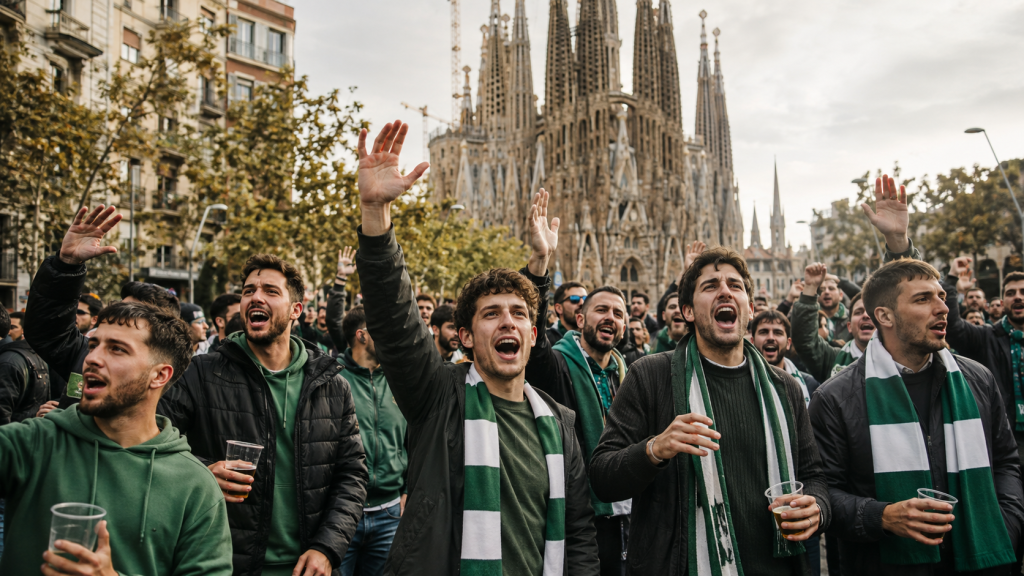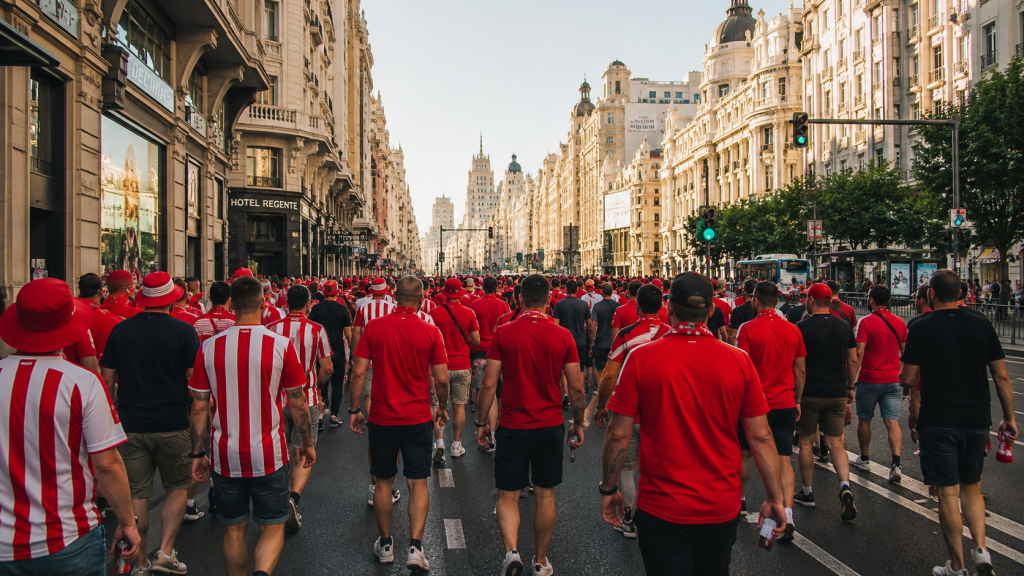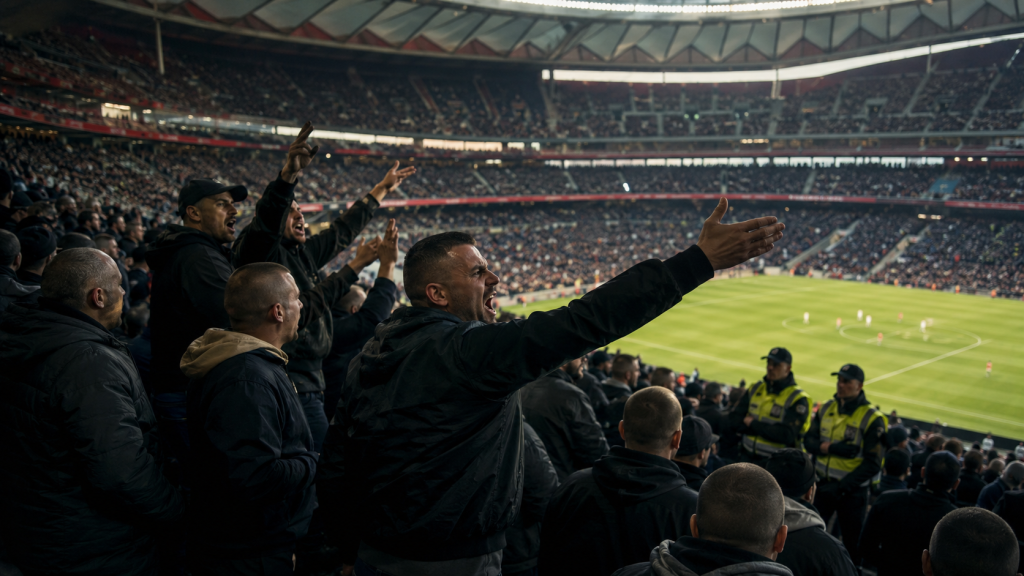
Quick answer: Good football fan safety in Spain starts before you reach the stadium. Check the host club’s official away-supporter information, carry the correct ticket and identification, know which items are prohibited, follow the designated access and transport arrangements, and avoid taking flares, fireworks, weapons or other restricted objects to the ground. If police or stadium security intervene, stay calm, follow lawful instructions and seek legal advice if the situation develops into detention, a fine or another formal procedure.
For travelling supporters, Spain is generally an easy country in which to attend football, but matchday rules can differ significantly from those at home. Spanish law establishes national rules on access, security and behaviour at sporting events, while clubs, competition organisers and police may also introduce match-specific arrangements.
This guide explains the main precautions foreign supporters should take before, during and after a football match in Spain.
Football fan safety in Spain: check the match information before you travel
Do not rely only on supporter forums, social media posts or information from previous seasons. Before travelling, check the latest information issued by the home club, your own club, the competition organiser and, where relevant, local authorities.
Pay particular attention to:
- Your allocated entrance and stadium sector.
- Whether identification is required with your ticket.
- Bag-size and prohibited-item rules.
- Official away-supporter meeting points.
- Recommended transport to and from the stadium.
- Any restrictions applying to banners, flags or flagpoles.
- Opening times for away entrances.
- Any special instructions for a high-risk or high-profile fixture.
- Match-specific instructions can change, so check them again shortly before kick-off rather than assuming the arrangements will be the same as for another fixture in the same stadium.
What items are prohibited at football stadiums in Spain?
Spain has specific national legislation governing safety at sporting events. Under Law 19/2007 on violence, racism, xenophobia and intolerance in sport, spectators are prohibited from bringing, carrying or using weapons or objects capable of producing similar effects, as well as flares, firecrackers, explosives and other inflammable, smoke-producing or corrosive products.
Do not take pyrotechnics to a football stadium in Spain. A flare that may be tolerated in another football culture should not be assumed to be permitted in Spain.
Spanish regulations also allow organisers to restrict objects that could be used as projectiles. The safest approach is to check the stadium’s official prohibited-items list before travelling to the ground.
Other common stadium restrictions may cover large bags, rigid containers, certain flagpoles, oversized banners or professional equipment. These details can depend on the venue and match, so the club’s official information remains important in addition to the national legal rules.
Can football supporters take alcohol into a stadium in Spain?
Spanish law prohibits the introduction, sale and consumption of alcoholic drinks inside sports facilities covered by the legislation. Access can also be refused where a person is under the effects of alcohol or drugs in circumstances covered by the law.
This does not mean that having a drink elsewhere before a match automatically prevents stadium entry. The relevant issue is the legal and stadium access rules applying at the ground and the supporter’s condition when attempting to enter.
Never try to conceal alcohol or another prohibited product during an access check. If stadium staff tell you that an item cannot be taken inside, the sensible course is to comply rather than turn an entry issue into a confrontation.
What should you expect at stadium security checks?
Spanish law requires spectators to submit to relevant controls designed to verify compliance with stadium access conditions. These can include personal searches aimed at identifying prohibited items.
The legislation also provides for security measures such as CCTV around entrances and inside certain football grounds. Professional football stadiums may operate extensive video-surveillance systems as part of their security arrangements.
During an access check:
- Have your ticket and any required identification ready.
- Follow instructions about the correct entrance or queue.
- Remove prohibited items if asked to do so.
- Avoid pushing through barriers or attempting to bypass a control.
- If there is a disagreement, remain calm and ask what rule or instruction applies.
- Do not physically confront a steward or police officer.
The fact that a check is inconvenient or slower than expected does not necessarily mean that your legal rights have been infringed. Equally, Spanish law provides that searches and security measures must operate with respect for personal dignity and fundamental rights.
Keep your ticket and stay in the correct away section
Your match ticket is more than proof of purchase. Spanish sporting-event regulations require spectators to have a valid title of admission and, where applicable, occupy the location corresponding to that ticket.
Supporters should therefore keep their ticket until they have left the stadium and be prepared to show it if requested by authorised stadium personnel or police.
Do not assume that you can move freely between home and away sections simply because empty seats are available. Rival supporters may be deliberately separated as part of the stadium security plan.
If you have accidentally bought a ticket in the wrong section, contact the club or your supporter liaison contact before attempting to enter rather than trying to resolve the issue at the turnstile.
Flares and pyrotechnics: do not assume foreign rules apply in Spain
Pyrotechnics are one of the areas where travelling supporters can make costly mistakes by assuming that the football culture of their home country applies abroad.
Spanish legislation expressly restricts flares, firecrackers, explosives and similar products at sporting venues. The implementing regulations provide for pyrotechnic displays only in controlled circumstances involving authorised professionals, the organiser and the Security Coordinator.
A supporter carrying or activating a flare is not in the same legal position as an authorised professional display organised by the event.
If your group is planning a display, choreography, banner or other organised activity, obtain written confirmation from the relevant club or organiser in advance rather than assuming permission.
Behaviour inside the stadium
Spanish law establishes conditions that supporters must observe while remaining inside a sporting venue.
These include prohibitions relating to:
- Violence and public disorder.
- Throwing objects.
- Unauthorised entry onto the pitch.
- Possession or use of flares and similar prohibited products.
- Violent, racist, xenophobic or intolerant conduct.
- Failure to comply with applicable safety conditions.
Supporters must also comply with the internal regulations of the stadium and may be required to leave where the legal conditions for remaining inside the venue are not met.
A stadium ejection is not necessarily the same thing as a criminal arrest or an administrative sanction. These are different legal situations and should not be confused.
Follow police instructions around the stadium
Spanish football matches can involve significant police operations, particularly where large numbers of away supporters are travelling or a fixture has heightened security requirements.
Under Royal Decree 203/2010, police security arrangements can extend to the stadium, its surroundings and the movement of supporter groups to and from the venue.
This can result in designated routes, temporary restricted areas, controlled access points or instructions about when and how away supporters should approach or leave the stadium.
If police direct your group towards a particular route or ask supporters to wait temporarily, do not attempt to break through a police line or leave a controlled group simply because another route looks quicker.
If you believe police action has been unlawful or disproportionate, record the relevant information when it is safe to do so and obtain legal advice afterwards rather than escalating the situation physically.
What to do if trouble starts nearby
You do not need to be directly involved in an incident for a crowded situation around a stadium to become difficult quickly.
If fighting, disorder or a confrontation begins nearby:
- Move away if it is safe to do so.
- Do not join a crowd merely to see what is happening.
- Follow police or steward instructions about where to move.
- Keep your hands visible if police are intervening in a group.
- Do not interfere with an arrest or police operation involving another supporter.
- If someone is injured or there is an immediate danger, contact the emergency services.
The European emergency number 112 can be called free of charge for police, ambulance or fire emergencies.
Save important contacts before matchday
Preparation becomes especially important when you are in another country and may not speak the local language.
Before travelling to the stadium, save:
- Your club’s supporter liaison contact.
- The host club’s relevant supporter information.
- Your accommodation details.
- Your country’s embassy or consulate details.
- Your travel insurance contact.
- 112 for genuine emergencies.
- Contact details for legal assistance in Spain if your trip has a particular risk profile.
If you are travelling as part of a supporters’ group, it is also sensible for more than one person to have copies of important travel and contact information.
Protect your passport, phone and travel documents
Crowded transport, queues and stadium concourses create obvious opportunities for belongings to be lost or stolen.
Keep your passport or identity document secure and avoid repeatedly taking it out unless it is required. Store a secure copy separately and make sure you can access important booking information if your phone is lost or its battery runs out.
If your passport or identity documents disappear during an away trip, see our guide on what to do if you lose your documents while travelling to a football match abroad.
What if you are detained or taken to a police station?
A police detention is different from an ordinary stadium security check or ejection.
If you are formally detained, do not physically resist and do not sign a statement or other legal document you do not understand. Ask why you are being detained, request legal assistance and ask for an interpreter if you do not understand Spanish.
The exact rights and procedure depend on the legal situation. Foreign supporters should obtain individual advice rather than relying on general matchday guidance once a police or judicial procedure has started.
You can also read our guide to football supporter rights across Europe for broader information about travelling as an away supporter.
Before flying home after a legal incident
If the match has resulted in police paperwork, a fine, a court appearance or another formal procedure, do not assume that leaving Spain makes the issue disappear.
Keep every document you receive and make sure you understand:
- What type of procedure has been opened.
- Whether there is a deadline.
- Whether you must attend another hearing.
- Where future notifications will be sent.
- Whether your lawyer needs to take action after you return home.
Administrative proceedings, criminal proceedings, stadium sanctions and club disciplinary measures are different processes and can have different consequences.
How Legal Supporters can help travelling supporters
Legal Supporters provides legal assistance for football supporters travelling to Spain, including preventive advice, assistance following matchday incidents and legal defence where a formal procedure begins.
For supporter groups, fan clubs, Supporters’ Trusts, SLOs and organisations arranging an away trip to Spain, early legal preparation can also help identify match-specific risks and clarify how local rules apply before supporters arrive.
If a supporter is facing a police, court or sanction issue in Spain, contact Legal Supporters for legal assistance.
Frequently asked questions
Can I take a flare into a football stadium in Spain?
No supporter should assume that a flare can legally be taken into a Spanish football stadium. Spanish law specifically prohibits spectators from introducing or possessing flares, firecrackers and other pyrotechnic or inflammable products in the circumstances covered by the legislation.
Can security search me at a Spanish football stadium?
Spanish sporting-event legislation requires spectators to submit to relevant access controls and provides for personal searches aimed at verifying compliance with prohibited-item rules. These measures must operate with respect for dignity and fundamental rights.
Can I drink alcohol inside a Spanish football stadium?
Spanish law prohibits the introduction, sale and consumption of alcoholic drinks inside the sporting facilities covered by the legislation.
Can I be removed from the stadium for breaking the rules?
Yes. Failure to comply with legal conditions for remaining in the stadium can result in removal from the venue, without prejudice to any separate sanction that may be considered under the applicable rules.
Should I carry my passport to the match?
Check the official instructions for your specific fixture. Identification requirements can vary depending on the competition, ticketing arrangements and security measures. If original identification is required, keep it secure throughout the matchday.
What number should I call in an emergency in Spain?
Call 112 for a genuine emergency requiring police, ambulance or fire services.
Official sources
- Law 19/2007 on violence, racism, xenophobia and intolerance in sport – Boletín Oficial del Estado
- Royal Decree 203/2010 on safety and prevention at sporting events – Boletín Oficial del Estado
- European Union information on the 112 emergency number
For more practical information before travelling, visit the Legal Supporters football fan legal guides.
Legal information disclaimer: This article provides general information about football fan safety and stadium rules in Spain. It is not a substitute for legal advice on an individual incident. Match-specific rules, police arrangements and legal consequences depend on the circumstances and the regulations applicable to the particular event.